Showing posts with label Kevin Schafer. Show all posts

Wednesday, March 28, 2012

Foxes in Motion

Young Kit Foxes at Play
Motion-sensor activated camera traps are great tools - they sit patiently all night waiting for activity, and then spring into action, capturing behavior that the photographer never saw. There are hitches, of course: when the wind blows every blade of waving grass can trip the sensor so that you get hundreds of pictures of grass - in a variety of poses.

Here, I set up a trap at the entrance to an active fox burrow, hoping to get glimpses of young pups. Boy, did I ever... They burst out of the burrow and, like all kids, ran around like mad for the next hour. Composition? Forget it?  Nice, graceful, "feng shui" arrangement? Nada. Of the nearly two hundred shots I got that night, almost all were unusable and, as you can see, this was deftly cropped to create a composition out of a madcap romp of pups headed in every direction. (That's Mom or Dad in the background, keeping an eye on things)

Low productivity, but good fun.

Nikon D300, 18-200mm lens, Camera trap

Wednesday, March 7, 2012

Short Commute

Brant Goose on migration
Yes, I normally post pictures of animals taken in exotic locations worldwide. When I am home, I am normally behind a computer, editing or planning my next expedition. But every now and then I am lured into action by animals closer to home: in this case about a hundred yards from my house. As I went out this morning, I noticed a flock of Brant geese feeding along the edge of the beach and ran to grab my camera.
These small birds - like miniature Canada geese - pass by here every year en route to their breeding grounds in SW Alaska. They stop and rest and feed on eelgrass (their favorite food) along the shore.  Although hunted in the refuges where they breed (the name "refuge" being something of a misnomer), they are quite accustomed to people and cars along Alki Beach below our house, and are MUCH easier to approach here than they are in Alaska. I set up my tripod and my 500mm lens and started shooting, inching closer with every few shots, thinking I was in a good spot to capture some interesting behavior.
In the end I only got 4-5 minutes before the entire flock of 30-40 birds took off en masse. No, it wasn't me, but a pair of Bald Eagles passing overhead. These B-52's of the bird world were enough to send these little geese up: they never returned. This simple shot of one calling along the shore was the best I got; I just hope they come back tomorrow.

Nikon D300 with 500mm f4 lens

Thursday, March 1, 2012

Onto FACEBOOK...finally

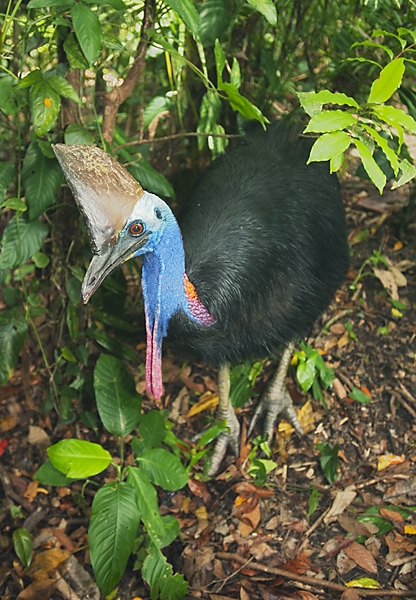
Female Cassowary, Queensland, Australia
OK, I have made several false starts on Facebook before, but now have decided to step firmly out of the Dark Ages and embrace the inevitable. The enormous, global reach of the site is hard to ignore : I am hearing from people in India, South America and my own backyard - people who might never stumble onto this humble blog.

So I am pleased to announce that I will now be posting on Facebook as "Kevin Schafer Photography" - come visit anytime!  I will, meanwhile, keep this blog going whenever I can.

Meanwhile, this is a portrait of an adult wild Cassowary in northern Queensland. I was shooting from a raised platform, which explains the unexpected angle. To be honest, these birds were being unexpectedly aggressive during my last visit - so I was playing it safe...

Nikon D3 with Nikkor 17-35mm

Monday, February 20, 2012

In the Mangroves

Red Mangroves, Los Haitises National Park, Dominican Republic
Los Haitises is the Dominican Republic's largest national park, an almost inaccessible wilderness of steep karst pinnacles, dense rainforest, and the largest collection of coastal mangroves in the Caribbean.  It is also just over an hour from Santo Domingo, the nation's capital, but so little known or understood that a plan to build a vast cement plant at the edge of the park was seriously considered - until public opposition stopped it.

I spent only a few hours here, mostly photographing some of the thousands of caves - some of them decorated by ancient Taino art - and the tangled mangrove stands. These red mangroves caught my eye and I stood in the bow of a small boat photographing the wonderful patterns of stilt roots. When I got home, I decided that the image lacked color, and looked better in black and white, so I made the conversion. The result?  A riot of lines and curves - good fun.

Nikon D3 with 17-35mm lens

Monday, February 13, 2012

Chasing Rare Lizards

Hispaniolan or Ricordi's Ground Iguana (Cyclura ricordi), Dominican Republic
This handsome fellow is one of the last of his species, and finding him was one of my primary goals for my ten-day trip to the Dominican Republic.  Although critically endangered, they were surprisingly easy to find. Their last refuge, and the only place to have any hope of seeing them, is on Isla Cabritos in Lago Enriquillo National Park.

We went across the lake to the island at dawn, hoping for good light - and to avoid the brutal heat. This saline lake in the southern part of the DR is actually 40 meters below sea level and is the hottest spot in the country.  Reptiles like these only come of their burrows when the temperatures allow, so we had to wait for a short time until this one emerged, and move slowly to avoid driving him back underground.

In the end, I found only 2 of these rare lizards, but I was most pleased with the simple portrait, the morning light subtly highlighting his striking red eye. However, I was also happy to get at least one shot of the other animal - a female - feeding on cactus fruit.


By eleven o'clock, the light was long gone, and the heat unbearable, so we retreated. I'm guessing the iguanas couldn't have been happier on both counts.

Nikon D3, 70-200 Nikkor lens

Wednesday, February 1, 2012

Playing Hooky in Hawaii

Nene Goose stretching, Kauai

Just returned from a welcome family vacation in Hawaii – a nice break
 from the recent cold snap in Seattle. To make it a true vacation, I took
 only one camera body and one lens (albeit the handy Nikon 
18-200mm) rather than the usual 50-60 lbs of gear I normally haul 
around.  This is a great lens for snapping the grandkids surfing, and 
(with the benefit of a sturdy plastic bag) shots of them underwater in 
the resort pool.
But since I don’t get to Hawaii all that often, I took a few hours off from 
the pleasures of grandparent-hood and went looking for Nenes – the 
endangered Hawaiian Geese. Although threatened by habitat loss, 
they are not hard to find in a few locations on Kaua’i, most notably 
at Kokee State Park and all along the north shore.
I was lucky on this occasion to 1) find them easily, 2) have bright
overcast light (full sun can be a picture-killer) and 3) to find adults
without the ubiquitous numbered leg bands. These bands help
scientists ID and track birds, but look a little jarring in a picture.


These particular Nenes seemed to like hanging around parking and 
picnic areas – apparently hoping to cash in on human discards. This 
made for some pretty unnatural backgrounds: car tires, yellow lines 
on asphalt, and garbage. In the end, however, I managed to find birds 
in more wild settings, including a pair with a young chick. 
Photographing that chick, however, proved a challenge: like most 
parents, the adult Nenes were forever blocking my view to protect 
their little one.  Patience, and persistence, eventually afforded me 
a few quick glimpses, nothing more.
After an hour or so, the sun came out, the birds left, and my 
grandkids needed my attention. Would I have loved a little more 
time with the Nenes? Sure… But hey, this was a vacation and 
time with the grandkids is almost as rare as these birds.

Nikon D300 with 18-200mm lens

Saturday, January 21, 2012

Best Laid Plans

Female Cassowary Drinking

Well, I had the best intentions.  I have just returned from my trip to Australia where I spent ten days following wild cassowaries through the Queensland rainforest - a project that I fully intended to document on this blog. That is, until the logic board on my laptop failed, rendering the computer unusable. Since I use this to store and edit pictures - and to post to blogs etc. - I was silenced. I picked up the repaired laptop on my way to the airport - on the way home...

Tech discussion as follows:

Me : "What makes the logic board go bad?"

Tech-guy: "No idea."

Me: "Sounds illogical to me."

Anyhow, I will try to reconstruct some of the events of the trip in the next week or so as I get the pictures edited.

This image is of an adult female - the only one I saw during my stay, drinking water out of a rainforest pool. Cassowaries cannot lap up water like a cat, but must scoop it up with their bills, then tilt their head back to let it run down their throat. I was pleased to be able to show this.

Nikon D3, 70-200mm lens

Wednesday, January 4, 2012

Cassie Diary

Bashing Through the Forest
Last month, I got the call - a message from friends in Queensland, Australia that the male Cassowary that I have been following for several years had just emerged with five young chicks. Unfortunately, I was just leaving for Antarctica and couldn't leave immediately, as much as I would have liked to.

With that trip done, and other responsibilities out of the way, however, I am headed back to Australia next week. In the meantime, sadly, three of the young chicks have vanished, presumably taken by a feral cat seen in the area.

While I am there, I hope to post daily (or nearly) posts to this blog - a Cassie Diary - with pictures and stories from the Queensland rainforest.  Stay tuned.

Nikon D3 and 24-70mm lens

Wednesday, December 21, 2011

Unexpected Moments

Chinstrap Penguin (Pygoscelis antarctica)
I was pleased to be asked to return to Antarctica this month, as a lecturer on the National Geographic Explorer. It is one of my favorite corners of the planet and the timing was good: I am working on an updated version of my 2000 book Penguin Planet and would love to include as much new material as I can. And because I have quite limited time on the Antarctic Peninsula, I thought this would give me a shot at some new images of the 3 most common penguin species found there: Adelie, Gentoo and Chinstrap.

There was still a lot of snow on the Peninsula this season, and many of the nesting birds were arriving at their colonies to find them still buried. Although penguins generally choose nesting sites in areas that are among the first to be snow-free, sometimes a heavy snowfall defeats them. They can't lay their eggs on the snow, and can only sit there waiting for it to melt.

This Chinstrap was doing just that, sitting on a snowbank, several feet above what he had expected would be his nest site. When I started photographing him, he was drifting in and out of sleep, and I was just about to walk on when he suddenly woke up and had a stretch, opening his mouth in a wide yawn - and twisting his body into a contortion that I had never seen before - nor thought possible.  He held it for just a second...and then promptly went back to sleep.

So although it may look like he was warning me to back off, I can assure you it was a simple, extravagant stretch - born of boredom and frustration (or so I imagine).  Whatever the emotion, it created a striking image, even if slightly weird (like a feathered ball with handles), and I was grateful for it.

Nikon D3 with 70-200mm lens

Sunday, December 18, 2011

Vultures of the Sea

Northern Giant Petrel in Flight, Drake Passage
As big as an albatross, and a close relative, the giant petrel has been a constant companion on our voyage back from Antarctica. Giant Petrels are polar scavengers, eating the carcasses of  seals, whales and anything they might find at sea or on land. They can also be predators of penguin chicks and eggs.

Following the ship as we plow through the swells, petrels like these can soar effortlessly for hours, if not days, in the strong wind. This bird flew right along the ship at eye level, apparently curious, and I was able to get this portrait as he passed by the bridge wing. I used a flash to give him a little extra color in the gloomy light, and used a slightly slow shutter speed to give the background a silky motion.

With two long days at sea back to Ushuaia, photographing the world's greatest flying birds is an enjoyable distraction.

Nikon D3, 70-200mm lens